 EN
EN  DE
DE 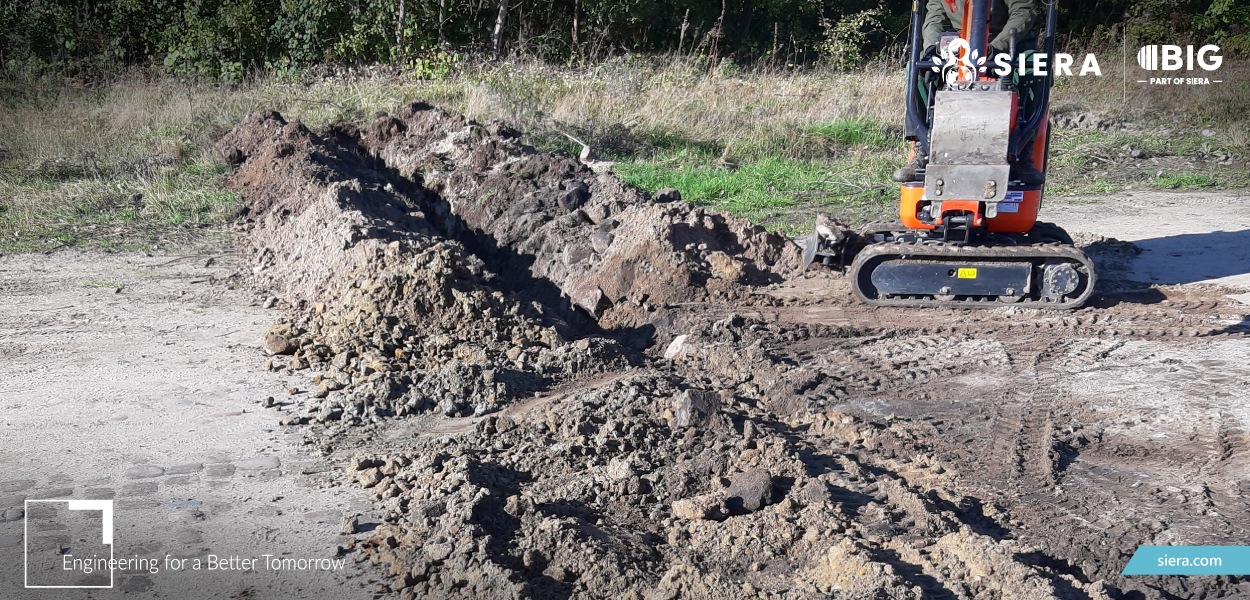
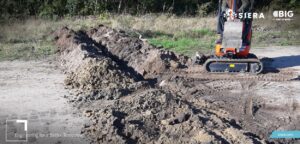
During pipeline construction and work on supply and disposal networks, excavated material is regularly produced that often cannot be completely reinstalled. It is becoming increasingly difficult for contractors to find suitable disposal options for this surplus material. The situation is particularly challenging when it is only a matter of Small quantities of mineral waste deals.
Many construction sites only produce a few cubic metres of material. Nevertheless, these quantities must also be assessed and sent for suitable disposal or recycling. However, the sampling and testing required for this can be disproportionately time-consuming and cost-intensive.
In addition, many construction measures cannot be planned in the long term. Particularly with Fault rectification on supply lines or short-term repair work, a preliminary investigation is often not possible. This results in additional organisational and economic costs.
A practical solution to this problem was developed by the Federal/State Working Group on Waste (LAGA) has been developed. This describes an appropriate and legally compliant procedure for handling small quantities of mineral waste in the LAGA Notice 32 (PN 98) and the supplementary Guidance on LAGA PN 98.
When implementing such solutions, the Prof. Burmeier Ingenieurgesellschaft mbH - Part of SIERA Alliance Construction companies, infrastructure operators and municipalities with technical expertise in the field of waste management.
Challenges in dealing with small quantities of mineral waste
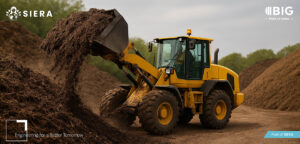
Infrastructure construction and pipeline work often lead to mineral residues that cannot be completely reused. Typical examples are
- Excavated material from pipe trenches
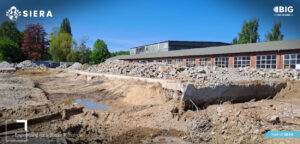
- Road demolition
- Concrete residues
- Natural stone material
- Paving stones or kerbstones
The disposal of these materials becomes particularly complex when only small quantities of individual construction sites arise.
Economic challenges
Small quantities of material often result in disproportionately high costs for:
- Sampling and analysis
- Transport and disposal
- organisational coordination
Technical challenges
Technical aspects also make it difficult to handle small quantities:
- Different material compositions
- Lack of preliminary investigations
- Limited disposal options
Legal requirements
At the same time, numerous legal requirements must be complied with, for example:
- Requirements of the Circular Economy Act
- Documentation obligations
- Prohibitions on mixing waste
A structured approach is therefore crucial in order to fulfil both economic and legal requirements.
LAGA specifications as a practical solution
With the LAGA Notice 32 (PN 98) and a supplementary guideline have created a framework that makes it much easier to deal with small quantities of mineral waste.
A central component of this recommendation is the possibility of, Combine small quantities of the same types of waste, to enable a joint examination and disposal.
This approach has several objectives:
- Increased efficiency in sampling
- More economical disposal
- Better recycling options for mineral materials
The practical implementation of such concepts is one of the fields of activity of the Prof. Burmeier Ingenieurgesellschaft mbH - Part of SIERA Alliance, which supports construction projects in the area of waste management and material assessment.
Merging small quantities into piles
According to the recommendations of the LAGA, mineral waste of one type of waste originating from different construction sites may be brought together in a suitable area.
Small quantities can be removed from the construction site without prior testing and transported to a Pile be summarised.
The most important framework conditions are shown in the following overview.
| Parameters | Default |
| Maximum weight per individual quantity | up to 20 tonnes |
| Maximum volume per individual quantity | up to 15 m³ |
| Maximum volume of a storage unit | up to 200 m³ |
| Purpose | Joint sampling and disposal |
This approach makes sampling more efficient and economical, while at the same time improving the utilisation possibilities.
Prerequisites for the merger
Several conditions must be met for the consolidation of small quantities to be authorised.
Organoleptic testing
First of all, it must be ensured that Non-hazardous waste is involved. This is done by means of an organoleptic test in which the following characteristics, among others, are assessed:
- Odour
- Colour
- Visible foreign components
This initial assessment serves as a plausibility check.
Exclusion of unauthorised mixing
Merging must not lead to pollutant levels being increased by mixing Diluted become.
Therefore:
- Materials with different loads must be kept separate
- the merger may only serve organisational purposes
Handling contaminated materials
If there are indications of increased pollutant loads - for example due to foreign components - these materials must be analysed:
- Stored separately
- analysed
- be evaluated
The Prohibition of mixing in accordance with Section 9 (2) sentence 2 KrWG excludes the possibility of merging with other waste in such cases.
Sampling according to LAGA PN 98
After the formation of a pile, sampling is carried out according to the specifications of the
LAGA Notice 32 (PN 98).
The number of samples required depends on the Volume of the pile.
The aims of this study are
- Evaluation of the material quality
- Determination of suitable disposal routes
- Ensuring legally compliant treatment
As part of such investigations, the Prof. Burmeier Ingenieurgesellschaft mbH - Part of SIERA Alliance construction projects in the professional sampling and assessment of mineral waste.
Single-variety removal of different types of waste
In addition to the consolidation of small quantities, the Separate removal of materials an important component of efficient waste management.
If technically possible and economically viable, different materials should be separated during the removal process.
A distinction must be made in particular:
- Finishing asphalt
- Road demolition containing tar or pitch
- Hydraulically bound road rubble
- Natural stones
- Concrete blocks such as paving or kerbstones
- Foundations
By separating materials in this way, they can be channelled into suitable disposal or recycling channels.
Requirements for temporary storage
Different materials must also be kept separate during interim storage.
This separation serves this purpose:
- avoid unauthorised mixing
- comply with legal requirements
- ensure suitable disposal routes
A structured warehouse organisation is therefore an important part of legally compliant construction site management.
Contribution of Prof. Burmeier Ingenieurgesellschaft mbH
If you have any questions about the disposal of waste generated during construction work, the Prof. Burmeier Ingenieurgesellschaft mbH - Part of SIERA Alliance comprehensive support.
The services include, among others:
- Advice on disposal concepts
- Evaluation of mineral construction waste
- Planning economical disposal routes
- Support in complying with legal requirements
A particular focus here is on economic and at the same time environmentally compatible solutions in the area of waste management.
Dealing with small quantities of mineral waste presents construction companies and infrastructure operators with organisational and economic challenges. Sampling and disposal can be particularly complex in the case of short-term construction projects.
However, the LAGA's recommendations for action offer a practical solution. By combining small quantities into piles, structured sampling and the separate treatment of different materials, disposal processes can be organised efficiently and in compliance with the law.
With technical support from experts such as the Prof. Burmeier Ingenieurgesellschaft mbH - Part of SIERA Alliance construction companies can implement these requirements safely and economically.
Are you planning construction or infrastructure measures and need support in dealing with mineral waste?
The Prof. Burmeier Ingenieurgesellschaft mbH - Part of SIERA Alliance will be happy to advise you on economical and legally compliant solutions in the field of waste management.
Contact our team of experts and find out more about sustainable disposal concepts.
Engineering for a Better Tomorrow