
 EN
EN  DE
DE 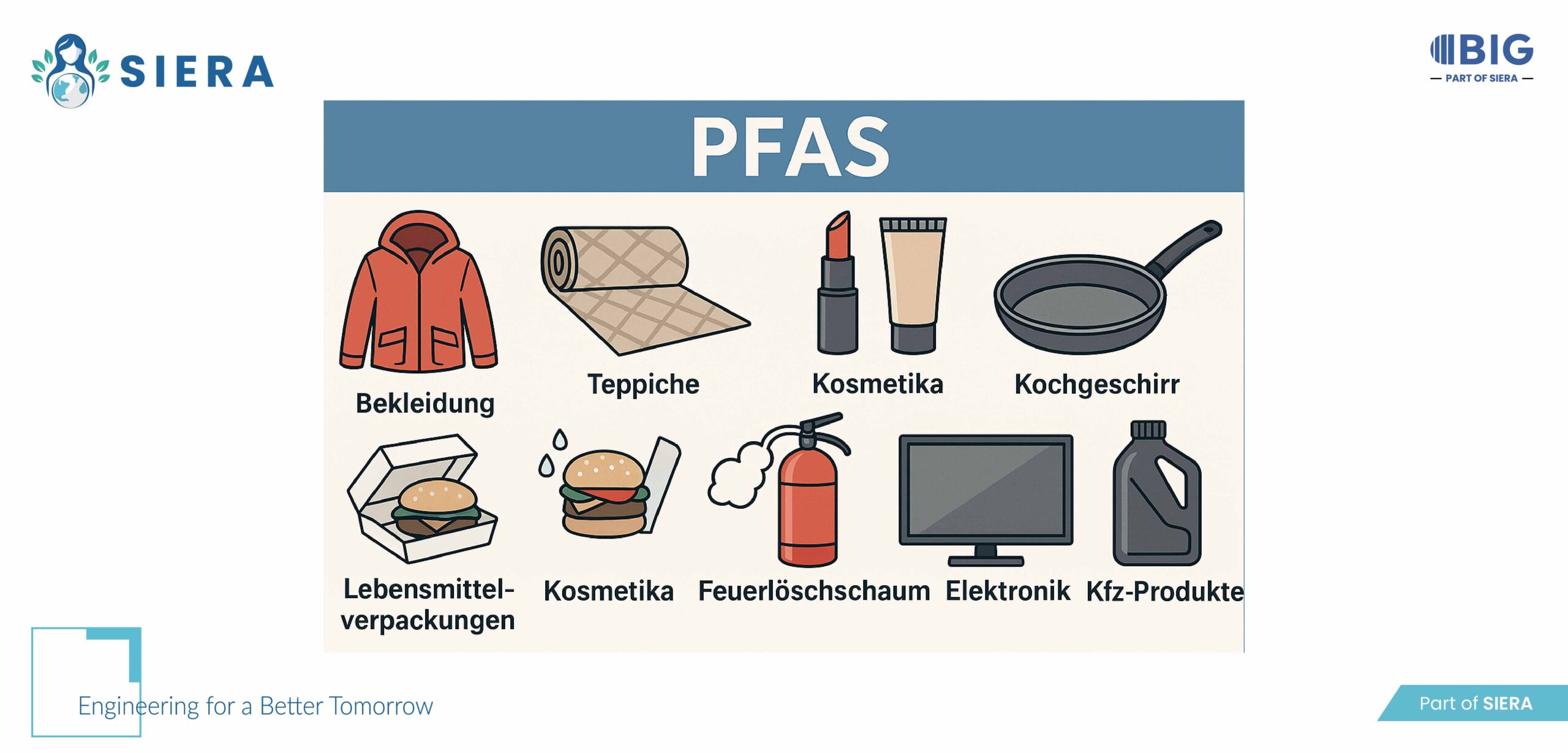
PFAS - from miracle cure to widespread pollutant
Perfluorinated and polyfluorinated alkyl substances (PFAS) were long regarded as technological miracle cures. Today, they are the focus of environmental and health protection, as they have proven to be extremely persistent and widespread. At the Hanover site, Prof. Burmeier Ingenieurgesellschaft mbH BIG - Member of the SIERA Alliance This group of pollutants is the subject of intensive research. The following content sheds light on the origin, properties, environmental behaviour and remediation approaches of this group of substances and shows why PFAS represent one of the major challenges of modern environmental technology.
Background and areas of application of PFAS
Due to their water, dirt and grease-repellent properties, representatives of perfluorinated and polyfluorinated alkyl substances (PFAS, also known as PFC - perfluorinated and polyfluorinated chemicals) can be found in a variety of everyday products such as outdoor jackets, Teflon pans or coffee-to-go cups, but also in fire extinguishing foams. The PFAS group now includes more than 4,700 different substances.
In chemical terms, these are organic compounds with different chain lengths in which the hydrogen atoms have been partially (polyfluorinated) or completely (perfluorinated) replaced by fluorine atoms. These carbon chains still have acid or alcohol groups. The bond between the carbon and fluorine atoms can only be destroyed again with a high energy input, e.g. in waste incineration plants. Complete bacteriological or photochemical degradation is not possible.
Environmental behaviour and risks
As these substances do not degrade in nature and therefore remain in the environment for a long time and are also highly mobile, they pose a significant environmental problem. Some PFAS can accumulate in plants, animals and humans and are also harmful to health.
PFAS can be released into the environment, for example from the exhaust air of industrial processes, but also from the domestic living environment, e.g. from impregnation sprays, via vapours from dirt-repellent treated textiles or via wastewater and the resulting sewage sludge, and thus enter the food chain. PFAS also become problematic because some of them bind to proteins in the human body and are sometimes passed on to the child in increased concentrations during pregnancy or breastfeeding.
Global distribution of PFAS
In addition to Europe-wide, partially increased contamination of groundwater by PFAS, studies have shown that they can be detected everywhere in the soil. Studies in the Arctic show that PFAS can be detected in fresh water as well as in marine waters, glaciers, air and snow, but also in fish, whales, birds and even phytoplankton.
With increasing scrutiny, PFAS are being detected in more and more analyses. It can be assumed that this group of pollutants is widespread.
Remediation approaches and responsibility
At present, PFAS-contaminated soils can only be remediated by high-temperature treatment; in the case of contaminated groundwater, purification with activated carbon is possible in principle.
PFAS is just one of many pollutants that are to be removed from the environment as part of remediation measures to make our world a better place. Engineering for a Better Tomorrow.